It seems so logical that everyone would get behind a good idea. But unfortunately, our industry doesn’t operate on logic alone. So be sure to put those good ideas in the spotlight, even if the person who came up with them doesn’t want to be there.
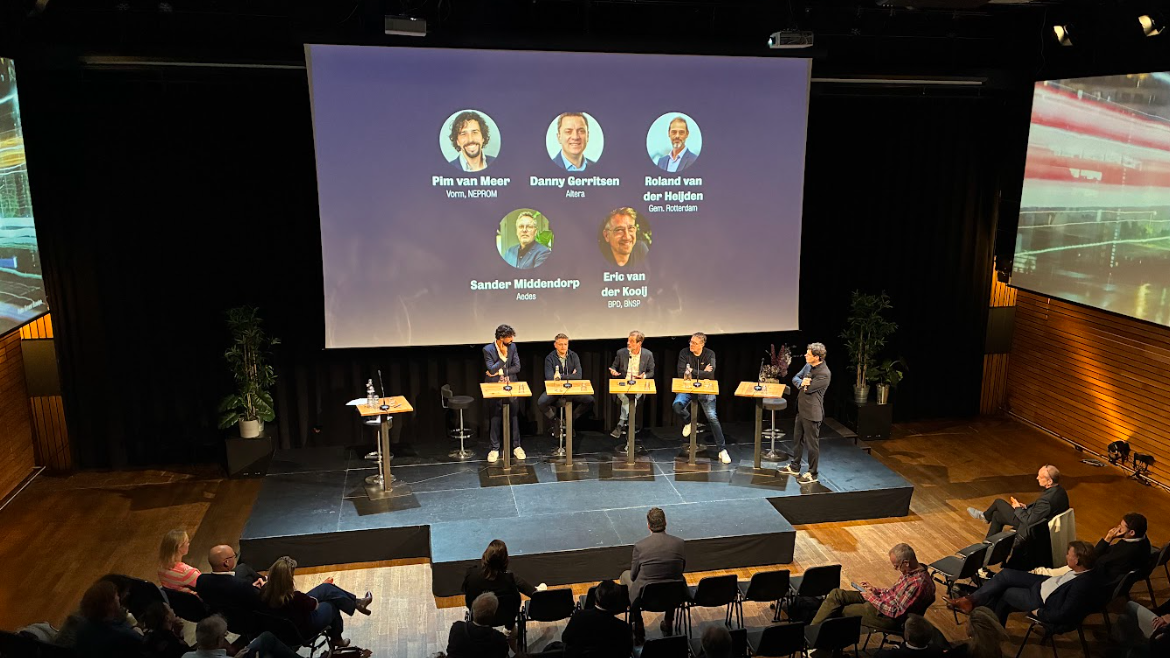
We were live at Pakhuis de Zwijger with #DankAanDeNerds. Government ministries, Aedes, IVBN, housing associations, developers, builders, and the City of Rotterdam were set to discuss transparent collaboration and better decision-making using digital information. Then one of the speakers—the investor—called in sick, leaving a seat open. I asked Michael de Jong from BIMsentry to fill in. A software vendor. That’s right.
Some vendors have their solution ready before they even understand your problem. In the demo, anything is possible. Then, during the project, you find out what “on the roadmap” really means. Michael is different. He listened first.
At VORM, we had a problem. Consultants submit models that are missing agreed-upon information—who hasn’t run into this problem? Colleagues then don’t check them thoroughly enough and move on. So those models end up skirting the issue instead of addressing it, and later in the process, that causes everything to grind to a halt. And then, as the “Judging Judge,” it’s up to me to figure out who was supposed to deliver and verify what. Everyone’s frustrated, and no one’s any closer to a home.
Of course, that’s also our own responsibility. Apparently, we’re not doing a good enough job of explaining why the next colleague needs that information. What we needed was a digital validation message that would allow advisors to immediately and visibly demonstrate that their work meets the standards—an idea from our COO.
Michael built that gatekeeper.
His software checks whether the agreed-upon information is available: space requirements for feasibility studies, housing types for buyers, materials for visualizations and building physics, and codes for cost estimation and procurement. Developed to meet our needs, based on national and international standards. So it’s also highly useful and scalable for others.
My takeaway: better data, fewer escalations, and less need to play referee. That’s exactly why I wanted this startup—which really listens—on that stage. “Tell us how you listen to the supply chain,” I asked. “How you solve a real problem. Leave the sales pitch at home.”
But Michael said no. He thought it was too nerve-wracking. And I understand that, because it really is. I still struggle with that myself, even though I do it fairly often. Still, I thought it was a shame.
But wait a minute.
I want suppliers who listen, stay humble, and deliver. Then I expect them to effortlessly win over an audience, too. So why should Michael have to do that all by himself? I benefit from his solution, so I should also be able to explain why it works. The same goes for colleagues who benefit from a good idea but leave all the persuasion to the person who came up with it. Understanding isn’t the same as taking action. A single enthusiastic presentation doesn’t change the way things are done. Repetition is still necessary.
So, creators: keep explaining what problem you’re solving. And users: grab that microphone, too. Because a fantastic idea deserves more than just applause. It deserves people who put it into practice and take it further.
Thank you, Michael. I’d be happy to give you this platform.
#thanks-to-the-nerds
Read previous episodes of Pim’s Digital Maze here
This is an article from Construction and Installation Hub. Want to keep up with all the news from the construction and installation industry? Then take a look at the hub and sign up for the online community.
↗