Every construction project generates a wealth of information—from architectural drawings to BIM models. Yet, when it comes to renovation or demolition, we often don’t know which materials will be generated and which can be reused. That’s such a shame, says Sultan Çetin, a business developer at DigiC, a collaborative program that aims to accelerate circular construction through digitalization. “Why don’t we create ‘passports’?”
Çetin knows what she’s talking about. As a Ph.D. candidate at TU Delft, her research focused on topics such as material passports, AI, blockchain, and parametric design. These days, she works as a business developer at ROM Utrecht Region within DigiC, a public-private program that uses digitalization to make circular construction more scalable, affordable, and sustainable.
A major challenge
And according to Çetin, this presents a major challenge. Especially in a sector where many parties work on a building one after another, she sees digitization as a crucial link. “The construction industry still operates largely in silos, whereas circular construction requires designers, builders, manufacturers, property owners, and government agencies to share information earlier and make decisions together. And you have to arrange that in the early stages.”
For example, anyone who wants to incorporate reused building elements into a design needs to know early on where and when they will become available. Digital tools can provide that insight. At the same time, simulations, AI, and parametric design make it possible to compare design options more quickly. “You can work faster. With digitalization and standardization, you can improve productivity. That means you need less labor and can therefore save time—and, consequently, costs.”
Access to data throughout the entire lifecycle
A significant part of Çetin’s work begins with how information is passed on throughout a building’s lifecycle. She cites a housing authority as an example: “Upon completion, BIM models, drawings, and material specifications are provided. Years later, that information turns out to be scattered across various systems. After ten or fifteen years, they have to renovate that building, but by then it’s difficult to find the data. Either they can’t open the model themselves, or they don’t know exactly where to find it.”
This is a fundamental obstacle to circular construction. Without reliable information about the products and materials used, it’s difficult to determine what can be reused. At the same time, valuable practical knowledge is being lost. “Imagine if a maintenance company knew what works best and what doesn’t. If we had a feedback loop between housing authorities and maintenance companies, they could use that information more effectively when making future material choices.”
A Digital Challenge for the Industry
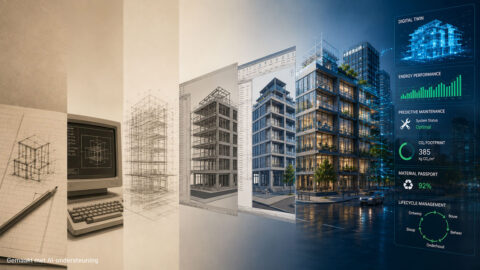
Part of the solution to that problem lies in material passports. Çetin describes the underlying idea as treating the built environment as a kind of materials bank. “We collect materials in buildings, and those buildings often have a lifespan of fifty to one hundred years. Why don’t we create passports so that, well before demolition, we can assess which materials are reusable, whether they contain harmful substances, and whether they meet the requirements in effect at the time of reuse?”
According to her, this can be done at various levels: from components and entire buildings to the material inventory of an entire region. A good example is the DigiC project in the Merwede neighborhood of Utrecht, where partners worked on an area-specific materials passport to provide insight into material use and future reuse. This makes it possible, for example, to determine in advance how much wood, concrete, or other materials will become available in the coming years.
At the same time, another development is on the horizon: the Digital Product Passport (DPP). According to the CPR (Construction Products Regulation), manufacturers will soon be required to provide a DPP for construction products covered by the new rules when they place them on the European market. This document specifies the product’s capabilities, how to use it safely, and the relevant technical information. This makes information on, for example, origin, composition, and disassembly available digitally.
These developments raise a new question, Çetin explains. “Buildings stand for about sixty years. How are we going to store that information for all that time? Should it be in some kind of European database? Or should it be something else?” For Çetin, this touches on the sector’s next digital challenge: not just collecting data, but ensuring that it remains accessible and transferable for decades to come. “This is something we’re investing in today for the future.”
Use AI to conduct a top-to-bottom assessment of a building
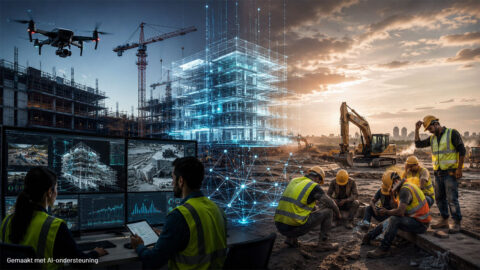
Where reliable data on existing buildings is lacking, technology can help collect it. As part of the “Hergebruik in Beeld” innovation project, DigiC is collaborating with an AI inspection company, a demolition contractor, and a specialized engineering firm to develop an approach for more quickly identifying reusable building elements using image recognition.
Point clouds, drone and satellite imagery, and scans are combined with the expertise of specialists who assess buildings prior to demolition. “We’re going to train the AI model using that expertise and knowledge. Our goal is to automate the data collection process so we can more quickly gain insight into which materials are available.”
It doesn’t have to stop at the exterior of a building. Inside, too, 3D scans can be taken and existing drawings and PDFs can be added. “You can combine different data sources to build a data-rich model. That can be a great solution for making decisions about a building.”
Data availability is the real challenge
But knowing what’s becoming available somewhere doesn’t necessarily mean that a window frame, beam, or facade panel will actually arrive on time for the next project. When asked whether supply and demand can now be digitally linked, Çetin replies succinctly: “That works to a limited extent.” Not because the technology is lacking. “In theory, it’s entirely possible. We have research, simulations, and solutions to make this happen. But often, there’s a lack of data on what materials are in buildings and when those buildings are scheduled for demolition. As a result, we don’t know enough about which materials will become available and when, even though that timing is crucial for matching supply and demand for reuse.”
For housing cooperatives, it’s often fairly predictable when buildings will be renovated or demolished. For private real estate, the situation is different. One possible step, therefore, is to combine data from housing cooperatives and public property owners to create a larger pool of materials. “Then, within the social housing sector, you have a pretty good idea of which buildings will be demolished, and you can do that matching. But the private housing stock is very difficult to map out.”
The factory as an accelerator
According to Çetin, factory-based construction also offers opportunities to apply circularity on a larger scale. She does, however, make an important point: circular construction does not automatically mean that every new building must consist of secondhand elements. “Industrial construction has a lot of potential, both with secondary and biobased materials.”
“It makes it easier to incorporate detachable connections as fixed components in the production process.”
According to her, the controlled environment of a factory can help apply materials with a low environmental impact on a larger scale, in such a way that components can later be easily disassembled and reused. In this way, digitalization, industrialization, and circularity can reinforce one another. After all, a highly digitized production process makes it easier to predict which materials are needed, while information about available raw materials and building components can be incorporated into the design and production processes.
For reused materials, that connection remains more complicated. A factory requires a predictable supply, whereas with secondary materials, it’s not always clear what will become available, when that will happen, or in what quantity or quality. According to Çetin, that same issue also applies to biobased materials. “Supply and demand are problematic across all types of construction methods.”
Digitalization remains one of the tools for achieving this. Ultimately, the business case must also change. According to Çetin, we currently focus primarily on the purchase price and not enough on factors such as CO₂ emissions, health, and other societal impacts. “The business case changes when we look not only at the purchase price, but also at factors such as CO₂ emissions, residual value, lifespan, and other societal impacts. Tools such as CO₂ pricing can help better incorporate these values into decision-making.”
The digital mapping of buildings and reusable materials is becoming increasingly tangible. According to Çetin, the challenge revolves around both reliable data and collaboration throughout the supply chain. To keep information available, up-to-date, and accessible during design, construction, use, and reuse, joint agreements and well-integrated systems are needed. To this end, DigiC brings together companies, government agencies, and research institutions. Through concrete innovation projects, they develop and test cross-organizational solutions. In this way, the contribution of digitalization to a circular and future-proof built environment takes shape in practice.

This is an article from Construction and Installation Hub. Want to keep up with all the news from the construction and installation industry? Then take a look at the hub and sign up for the online community.
↗