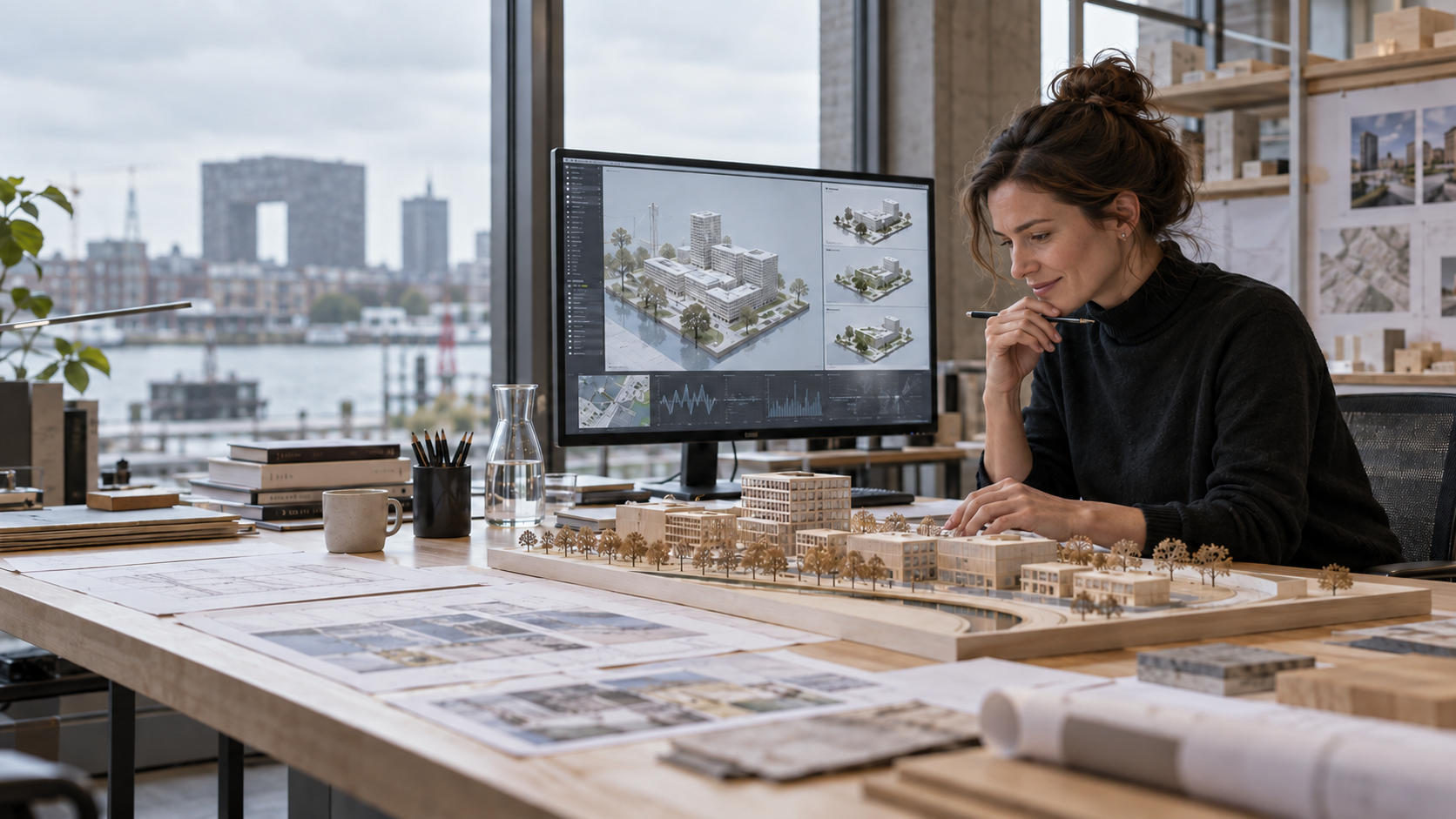
AI has already made its way into virtually the entire design process at architectural firms. The greatest impact is currently visible in the creation of visualizations, but the technology is also gaining ground in analyzing requests for proposals, developing ideas, and exploring design studies. This is evident from a survey conducted by Architectenweb among 53 architectural firms. The question is less and less whether AI is being used, and more and more how firms are making the most of its capabilities.
The time savings are appealing. AI can search through information faster, generate variations, and present designs more persuasively. This creates more room to reflect on the core of a design. Some firms are already integrating various AI tools into a single system so they can share information and workflow steps. Many firms are still in the early stages of this; at the same time, many architects see opportunities to link AI more flexibly to firm-specific knowledge, similar projects, and BIM.
Relationships Are Changing
This acceleration also raises new questions. AI-generated answers can sound convincing yet still be incorrect. Privacy and the confidentiality of project data require careful decisions, while it is not always easy for busy firms to build up the necessary knowledge or training. The relationship with clients is also changing: about half of the architects surveyed have noticed that clients expect more work to be delivered faster, sometimes for a lower fee. AI speeds up production, but that speed can further raise expectations.
Pros and Cons
This also brings the quality of the design into focus. A slight majority of participants expect that AI can enhance architectural quality. At the same time, architects warn against generic results and the loss of professional expertise when designers delegate too much of the thinking process. After all, design requires more than just production: it requires careful consideration, collaboration, imagination, and responsibility.
Architects continue to call the shots
In the coming years, work and roles at architectural firms will shift. Architects anticipate a growing need for people who can effectively manage AI and critically evaluate its results. While the technology can provide significant support, the architect’s knowledge and decisions remain decisive.
Architectenweb Knowledge Sessions during DigiBouw 2026
November 25, 2026, 11:45 a.m. – Theater 1: Next Steps in Parametric Design
Lennaert van Capelleveen takes you through the complexity of today’s design challenges and explains how as much data as possible is incorporated into the design process from the very beginning. Parametric design makes it possible to use that data to optimize designs to a great extent. The solar exposure of every facade is different, and parametric design allows the facade design to be precisely tailored to those conditions—that alone reduces interior heating, which makes a significant difference in the required building systems, which in turn has a profound impact on the design.
Architectenweb will welcome you in the lounge starting at 11:15 a.m. and will serve lunch starting at 12:45 p.m.
November 26, 2026, 11:45 a.m. – Theater 1: Toward overarching systems that connect AI tools with one another
Joon Hyung Park and Muamar Tabakovic take you on a deep dive into the various AI tools that architectural firms use in the development of designs. The problem is that these AI tools operate, so to speak, in their own silos, while a great deal of knowledge and information is already available elsewhere. With overarching systems, however, the knowledge accumulated from other projects—as well as all information about the project and its context—is taken into account, along with the information generated by the other AI tools.
Architectenweb will welcome you in the lounge starting at 11:15 a.m. and will serve lunch starting at 12:45 p.m.